

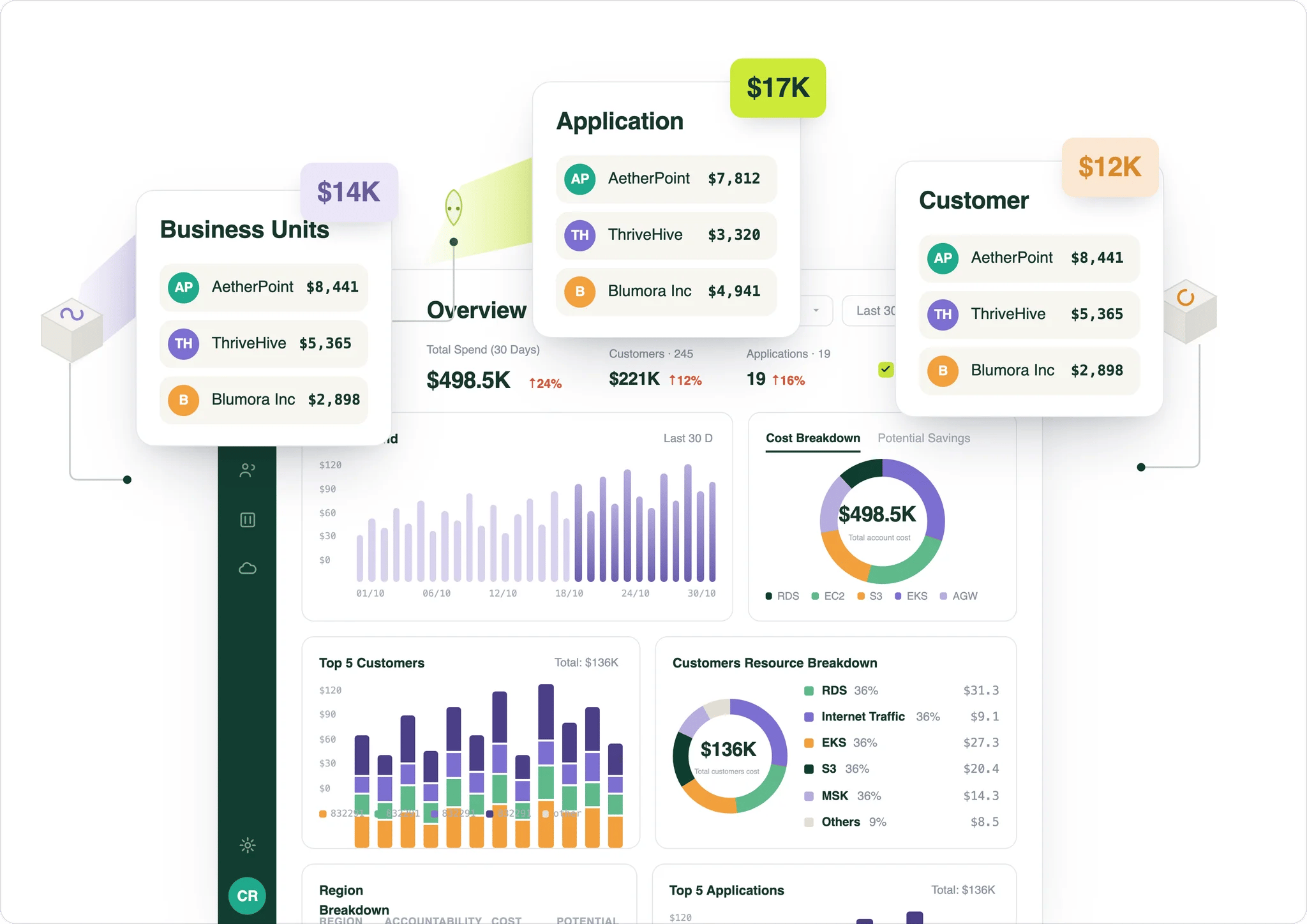
Everything your team needs to see.

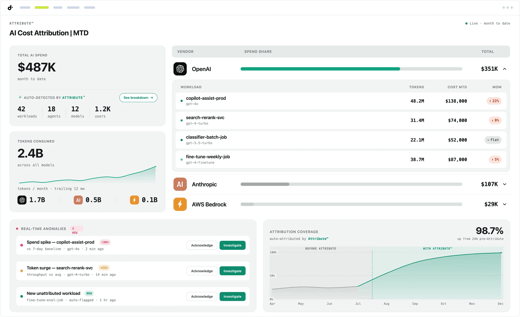
Four capabilities that close the cost accountability gap
How Tagless Allocations work?
We go beyond tag-dependent approaches by combining fallback logic, shared cost splitting, and multi-source grouping, so your allocation stays accurate even when tagging is incomplete or inconsistent across AWS, Azure, Google Cloud, Oracle or any of our 40+ supported clouds.
Flexible grouping
Allocate spend by team, service, or environment. No rigid tagging structures required.
Fallback logic
Fill gaps in tagging using labels, accounts, services, and usage metadata automatically.
Shared cost splitting
Distribute charges like support fees or egress traffic across teams or projects with precision.
Deep platform integration
Share anomaly data and context between engineering and FinOps teams natively.
Tagless FinOps in Action
So, how does it work?
Most tools read your billing exports. Attribute reads runtime data and maps costs to the workload that spent it. Attribute replaces months-long tagging programs with a lightweight runtime sensor.
Cloud Intelligence™ analyzes your live system
Traditional FinOps tools rely on old data
| Capability | Cloud Intelligence™ | Traditional FinOps tools |
|---|---|---|
| Allocation & Attribution | ||
| Cost attribution method | Automatically Based on actual workload behavior | Manual Billing exports filtered by manually applied resource tags |
| Time to meaningful data | Minutes Immediately after sensor is deployed | Days Weeks to months of tagging work before attribution is useful |
| Customer-level cost attribution | Automatically Maps cloud spend to each customer across shared infrastructure | Manually No concept of “customers”, cost-to-serve is a manual exercise |
| Self-managed infrastructure | Visible eBPF sees inside self-managed workloads | Invisible Kafka, Elasticsearch, RabbitMQ on EC2 never appear in billing exports |
| Shared resource allocation | Advanced Allocation reflects what actually happened | Basic Even splits or rough estimates |
| AI cost attribution | Full Consumption-based token allocation per feature, customer, or team | Partial Shows total LLM spend only |
| Data freshness | Real-time Cost is visible as workloads run | Delayed Anomalies surface after the damage is done |
Allocations
Make every dollar accountable
Most allocation tools depend on tags alone. DoiT solves the enterprise-wide challenge of mapping cloud costs to business context, even when tagging breaks down.
Group spend your way
Define rules by team, service, or custom combination across three clouds.
Fill tagging gaps
Fallback logic across labels, accounts, and metadata keeps views complete.
Split shared costs
Distribute support fees and egress across teams. No more misc buckets.
Track unallocated spend
See what's unallocated and why, and fix logic before it impacts reports.
No silos or spreadsheets
Natively powers Budgets, Alerts, Analytics, and DataHub in one platform.
Consistent allocation logic
Every report, widget, and policy uses the same rules automatically.



the problem
The cost accountability gap is real
Cloud bills are organized by tags, accounts, or projects, not by how your business operates. Shared services span multiple teams but show up as single charges. Tagging is hard to get right and even harder to maintain.
The FinOps Foundation's allocation capability calls this out directly: organizations need to map 100% of cloud costs to business context. Without fallback logic and shared cost handling, large portions of spend go unattributed, undermining trust in reports, budgets, and alerts.
FinOps aligned
Built for the FinOps allocation capability
The FinOps Framework defines cost allocation as mapping costs to the teams, products, and business units that consume them. It recommends using metadata beyond tags (accounts, labels, and resource hierarchies) to achieve full coverage.
DoiT Allocations implements this directly. Fallback logic chains multiple metadata sources together. Shared cost splitting distributes cross-team charges fairly. And real-time unallocated spend tracking tells you exactly where gaps remain, so you can close them before the next reporting cycle.
Minutes to investigate cost spikes (down from hours)
supported clouds: AWS, Azure, Google Cloud, Oracle and more
Target allocation coverage per FinOps Foundation Framework
Frequently asked
questions
How does DoiT Allocations differ from native cloud cost allocation tools?
Native tools rely heavily on consistent tagging. DoiT Allocations adds fallback logic that chains labels, accounts, services, and usage metadata together, so you get complete cost views even when tags are missing or inconsistent. It also handles shared cost splitting and works across AWS, Azure, and Google Cloud in a single interface.
What is cost allocation in the FinOps Framework?
The FinOps Foundation defines cost allocation as the practice of mapping 100% of cloud costs to the teams, products, features, or business units that consume them. It's a foundational capability that enables chargebacks, showbacks, budgeting, and accountability. The framework recommends using multiple metadata sources beyond tags to achieve full coverage.
How does fallback logic work?
You define a priority chain of metadata sources. For example, first check for a cost-center tag, then fall back to the account name, then to the service label. DoiT Allocations walks through this chain for each cost line item, so spend gets attributed even when the primary tag is missing.
Can I split shared costs like enterprise support or egress?
Yes. Allocations lets you distribute shared charges across multiple teams or projects using rules you define: proportional splits, fixed percentages, or usage-based distribution. No more lumping shared costs into a miscellaneous bucket.
Does Allocations integrate with other DoiT features?
Allocations is natively integrated across the DoiT platform. The same allocation logic automatically powers Budgets, Alerts, Analytics, and DataHub, so every report and policy uses consistent cost attribution without manual syncing or spreadsheets.
How do I track unallocated spend?
DoiT Allocations surfaces unallocated spend in real time, showing you exactly what portion of your bill isn't attributed and why. You can fix logic, update rules, or fill in missing metadata before it impacts reporting or budget enforcement.
See Tagless FinOps in action
Ready to stop relying on tags for allocation?